
Why green spaces win?
Across modern commercial developments, an unmistakable pattern has emerged: spaces anchored by living ecology consistently draw the largest crowds. From botanical lifestyle hubs to landmark transit destinations like Jewel Changi, which hit its 12-month target of 50 million visitors in just six months, human biology continues to dictate real estate viability. People instinctively linger where they feel restored, transforming passing footfall into dwell time, the lifeblood of retail spend and tenant retention.
The data behind footfall and dwell time
Many developers still write off landscaping as a cosmetic expense, but the commercial metrics tell a very different story. Research by Terrapin Bright Green reveals that daylight and living greenery keep visitors lingering up to 20% longer, lifting consumer spending by 8% to 12%. The shift happens biologically: exposure to natural foliage patterns measurably lowers human cortisol levels within three minutes, replacing transit fatigue with open exploration. Indoors, that environmental connection proves just as potent, with Harvard’s COGfx study linking well-ventilated, nature-integrated spaces to a 26.4% boost in cognitive performance.
Engineering the outdoors inside
Yet, bringing nature indoors frequently fails when treated as a superficial styling choice. “Dropping potted plants under cold, recirculated ceiling air conditioning doesn’t recreate nature,” says Kah Tzun, co-founder of KOY_LAB /ARCHITECTS. “To capture the pull of an outdoor destination, greenery has to shape how people actually move and breathe within the architecture.”
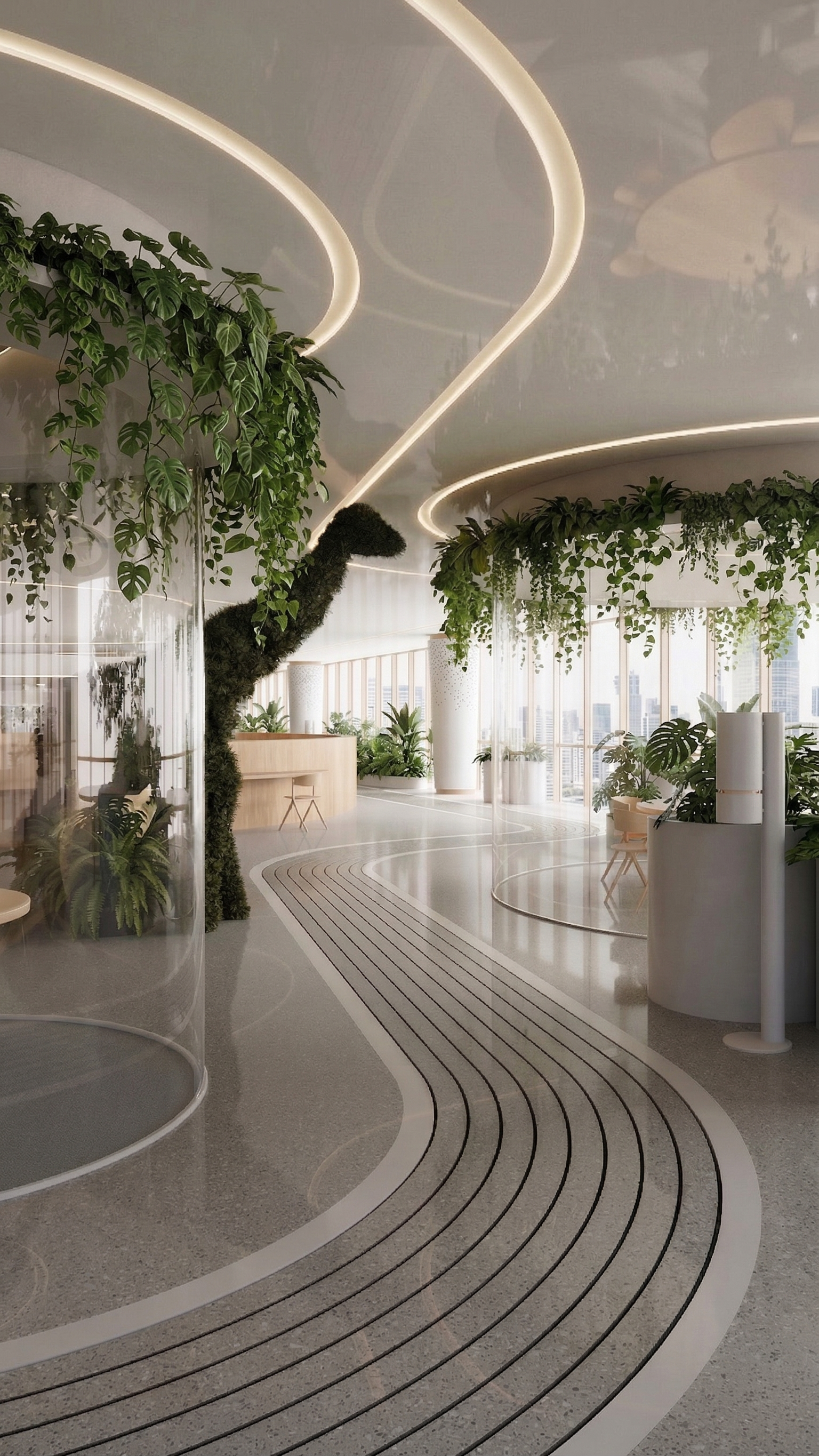
In Monolith Air-Grid, a 4,000m² workplace and commercial ecosystem conceived as an answer to the post-2020 isolation crisis, the practice translated the spatial freedom of an open park into an enclosed floor plate.
Instead of traditional corridors, an active running track meanders through the floor, weaving past tiered living planters and communal gathering pockets. The track doubles as the building’s breathing apparatus: an Underfloor Air Conditioning (UfAC) system gently feeds 99.97% HEPA-purified air upward from floor vents along the path. The displacement air simultaneously cools occupants and nourishes the plant beds, while slashing operational energy consumption by 30% and carbon emissions by 29%.
When living landscapes are engineered directly into circulation and air delivery, spaces naturally draw people in, delivering measurable returns in wellbeing, daily footfall, and operational performance.
Learn more about the project here.